Digging into 1-Bromo-5-Chloropentane: Substance, Story, and the Road Ahead
Historical Development
The journey of 1-Bromo-5-Chloropentane sprang out of both necessity and curiosity. Chemists always look for compounds that make synthetic pathways smoother, and this compound’s combination of halides offered just that. In the 1970s and 1980s, research in organic synthesis surged, as the pharmaceutical and materials science industries boomed. During this time, the demand for functionalized alkyl halides grew, partly because these molecules gave chemists a “handle” for further modifications. In labs like the one where I started my own career, researchers often pieced together complex molecules from simple building blocks. 1-Bromo-5-Chloropentane proved useful for studies in nucleophilic substitution and cross-coupling, leading to more efficient processes. The compound’s rise mirrors the broader push for precision in organic chemistry, a field where the smallest tweaks in structure can turn a tricky synthesis into a practical one.
Product Overview
1-Bromo-5-Chloropentane is not just another chemical on a shelf. It stands out as a bifunctional alkyl halide, mixing both bromo and chloro groups across a flexible pentane backbone. Holding the formula C5H10BrCl, the compound finds its way into a wide array of processes from small-scale lab reactions to industrial production of surfactants and certain agrochemicals. You’ll spot it among research chemicals for organic synthesis, and often industries working on intermediates for dyes or specialty materials keep stocks on hand. While plenty of alkyl halides float around in chemical catalogs, few combine bromine’s reactivity with chlorine’s selective kick over such a handy chain length, marking this compound’s place in the toolbox.
Physical & Chemical Properties
1-Bromo-5-Chloropentane looks like a clear to slightly yellowish liquid, not exaggerating its strong, somewhat sharp aroma typical of brominated organics. Its boiling point hovers between 195-198°C at standard pressure, and it clocks in with a density near 1.38 g/cm³—weightier than water, thanks to the bromine atom. It barely dissolves in water, preferring the company of nonpolar solvents, much like most haloalkanes. Chemical reactivity turns on both the bromine and chlorine ends; nucleophiles tend to pounce on the bromine, opening up the molecule for chain extensions, while the chloro group resists until harsher conditions. This difference offers pathways for selectivity in multi-step syntheses. Left in the open, it slowly picks up moisture, so tight storage pays off, something anybody who works with halides soon learns the hard way.
Technical Specifications & Labeling
Chemical manufacturers and suppliers sort out 1-Bromo-5-Chloropentane by purity, typically offering grades of 97% and up, with the rest composed of structurally related by-products. Bottles bear hazard pictograms for corrosive and environmental risks, and proper labeling makes clear the requirement to store in cool, dry, and well-ventilated spaces. On arrival in my first lab, stockroom staff drilled into us the importance of double-checking CAS numbers—111-43-3 for this one—since looking only at names can lead to mix-ups, given similar-sounding alkyl halides with different substitution patterns. Batch analyses back up technical sheets, offering gas chromatography and NMR data to reassure users about the compound’s identity. Barcodes and tamper seals on packaging reflect a shift over recent decades toward strict traceability in the supply chain.
Preparation Method
Laboratory and industrial prep of 1-Bromo-5-Chloropentane branched from classic halogenation techniques. The go-to approach starts with 1,5-pentanediol or 5-chloropentanol, which then reacts with phosphorus tribromide or hydrobromic acid to replace an -OH group with a bromine atom. Scale-up in industry brings better yields when using phase-transfer catalysts and controlled addition rates; I’ve seen bench chemists trade horror stories about runaway acidic fumes, underlining the need for disciplined handling of hydrobromic acid. Careful separation from dibrominated or dichlorinated side-products follows with meticulous distillation. Even minor contaminants undermine later steps in synthesis, especially for pharma or specialty polymer uses. Experience taught me that, despite its simplicity on paper, each scale brings quirks—a lesson in the gulf between textbooks and practice.
Chemical Reactions & Modifications
What makes 1-Bromo-5-Chloropentane so practical lies in its dual reactivity. The bromine end gives itself up quickly to nucleophilic attack—think Gabriel synthesis for making primary amines or in alkylating agents for forming quaternary ammonium salts. Meanwhile, the chloro end tags along for the ride, holding out for stronger conditions or acting as a functional placeholder until later steps. Chemists tailor reactions to exploit this difference, setting the stage for sequential substitutions. Popular transformations include turning the chloro group into a thiol or amine after the bromide’s gone. Colleagues working on novel surfactants use these steps to whip up custom headgroups or linkers. Modifications often extend to Grignard reactions, where only the bromine enters the magnesium’s grasp, or to Williamson ether synthesis, each one reinforcing the value of control and selectivity.
Synonyms & Product Names
Chemical companies often attach more than one tag to this molecule. Besides 1-Bromo-5-Chloropentane, stockists call it Pentamethylene Bromide Chloride or 5-Chloropentyl Bromide. The IUPAC system lists it as 1-Bromo-5-chloropentane without dash or other flourish, while catalogs and safety data sheets keep the identifier consistent with the CAS number to sidestep confusion. Nicknames in the lab can get even lazier–it becomes ‘BCP’ in shorthand for workups or notes. These overlapping names echo a time before standardization, but the real point is always double-checking before mixing, weighing, or ordering, since even minor differences can throw off a whole synthesis series.
Safety & Operational Standards
Handling 1-Bromo-5-Chloropentane demands respect. The compound can irritate the skin, eyes, and respiratory system; inhalation or accidental spills leave a real mark. MSDS documents push for neoprene or nitrile gloves, chemical splash goggles, and well-maintained fume hoods. Training drills on containment and spill management have evolved—back in the earlier years, these protocols seemed flexible, but stricter occupational safety guidelines have since tightened habits in both labs and production lines. Storage means shatterproof bottles and secondary containment, away from acids and oxidizing agents. Fire risk hovers over all haloalkanes, so readiness with foam or CO2 extinguishers counts as routine. Waste gets treated as hazardous and must go for professional disposal. Every time safety slips, the price can be more than ruined experiments; it can harm people you see every day.
Application Area
Diverse fields tap into this molecule’s reactivity and flexibility. Organic synthesis labs run through stocks of 1-Bromo-5-Chloropentane for multi-step reactions, especially in the making of intermediates for medicines or agrochemicals. Surfactant and specialty chemical developers depend on the chain for building molecules with precise hydrophilic or hydrophobic segments, a demand that keeps growing with the evolution of detergents and dispersants. Polymer research uses it to introduce unique functional groups into backbone chains, changing mechanical or thermal properties. Even the electronics sector—working on advanced materials for coatings or surface modifiers—see use cases here. In my own experience, it came in handy during synthesis of quaternary ammonium compounds used as phase-transfer catalysts, a niche but important area, especially when chasing higher efficiency reactions in water.
Research & Development
The pace of innovation urges chemists to probe deeper uses for “old” compounds, and 1-Bromo-5-Chloropentane plays its part. Current research pursues greener transformations and selective functionalization, aiming to cut down on waste and improve atom economy. Heterogeneous catalysis and microwave-assisted reactions have started to replace some traditional protocols, showing better yields or smoother scaling. High-throughput screening and computer modeling turn up new derivatives, looking for better performance in fields like pharmaceuticals, where chain length and substituents affect activity and bioavailability. Projects in agricultural chemistry, exploring novel pesticides or herbicide intermediates, also lean on the versatility of the bromo-chloro motif. For people new to industry, picking up on these trends signals where opportunities lie for innovation, job growth, and future products.
Toxicity Research
Toxicology has covered a lot of ground on alkyl halides, and 1-Bromo-5-Chloropentane carries the expected risks. Animal studies show moderate acute toxicity, with effects landing mainly on the nervous system and liver after prolonged exposure or high doses. Dermal exposure leads to irritation, sometimes severe burns, and inhalation provokes coughing, headaches, or worse. Regulatory agencies like the EPA and ECHA classify related compounds as potential environmental hazards due to persistence and toxicity in aquatic life. My years around bench work drilled in a kind of healthy paranoia—unseen vapors and small spills add up. Routine use of local exhaust ventilation, chemical-resistant gloves, and clear labeling in shared spaces are no longer optional. Toxicity research keeps expanding with in vitro and genomic studies, setting the bar ever higher for worker and environmental protection.
Future Prospects
The forward look for 1-Bromo-5-Chloropentane links to trends in sustainability and advanced manufacturing. Pressure mounts to develop biodegradable or less toxic analogs, as environmental standards toughen. Chasing milder, solvent-free processes, or swapping out halides in functional molecules, will probably steer future research and industrial adoption. Given persistent demand for tailored building blocks in pharmaceuticals, polymers, and surfactants, the compound will stick around as long as it keeps delivering effective results. Breakthroughs in catalysis or electrochemical conversions could shift the way this and similar molecules get synthesized and transformed. A push from both regulators and customers to lower environmental footprint will throw the spotlight onto improved handling, recycling, and eventual replacement, especially if green chemistry alternatives come up to speed.
Understanding Its Structure
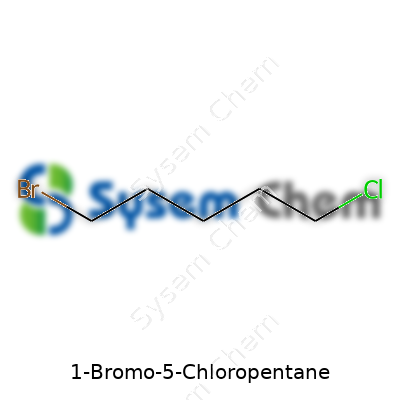
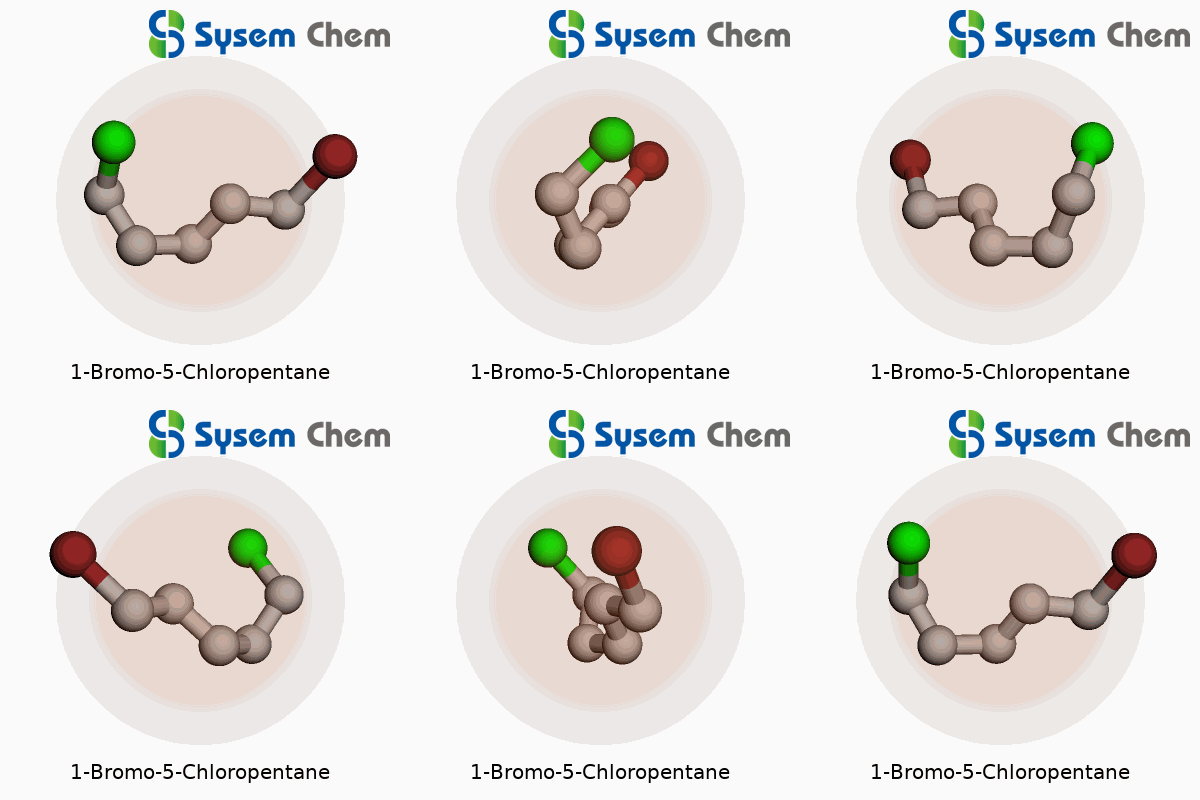
Chemistry class sometimes feels like chasing secrets hidden in a formula. Anyone who’s spent time in a lab remembers the rush of piecing together atoms. 1-Bromo-5-chloropentane looks simple at first. Take a five-carbon chain, slap a bromine at one end, chlorine at the other, and you’ve got its basic structure. Pentane forms the base: five carbons in a line, all saturated with hydrogens. Throw in one bromine on carbon one, one chlorine on carbon five, and count what’s left.
Writing it out, you get: C5H10BrCl. That means five carbons, ten hydrogens, one bromine, and one chlorine. The hydrogens drop from twelve to ten since each halogen swaps out a hydrogen as it attaches.
Why This Molecule Matters
It’s easy to skip past 1-bromo-5-chloropentane as if it’s just a dot on a long list of chemicals. Yet, picking apart structures like this sharpens the basic skills needed for organic synthesis. In school, these exercises train you to visualize chains, count connections, and spot patterns. It isn’t busywork—it’s real-world problem-solving. Many pharmaceuticals or advanced materials begin with molecules just like this, with small tweaks making a world of difference.
In industry, 1-bromo-5-chloropentane sometimes plays a supporting role in making other chemicals. Placing bromine and chlorine at distant poles of the molecule isn’t for show. It opens doors in synthetic chemistry: nucleophilic substitution reactions can swap out these atoms for everything from amines to thiols. The positions matter for scientists building complex scaffolds for drug candidates, polymers, or specialty solvents.
Safety Still Matters
Brominated and chlorinated compounds don’t just sit quietly in a bottle. They have bite. Over the years, I’ve seen strict protocols grow around such substances because their reactivity and volatility can sting you or the environment. Gloves, goggles, and decent ventilation don’t just show up for appearances; they’re non-negotiable. Stories circulate in every chemistry department—one careless move, and skin or lungs pay the price.
Long-term, halogenated organics pose waste issues. Some stick around in the water and soil much longer than most folks would expect. Incineration and advanced chemical treatment offer some answers, but prevention helps most. Chemists continue chasing greener halogen alternatives, recycling old materials, or reducing waste at the first step. Only buy or make what you’ll use—less storage means less risk and less waste in the back end.
Building Solid Foundations
Learning the structure and formula for something like 1-bromo-5-chloropentane trains more than just your memory. It sets the groundwork for the careful attention to detail science demands. Every time you get this foundation solid—a clean formula, correct handling, responsible use—you build trust in your own results. Forgetting those basics can cost projects, reputations, even health. The details stay as important in the lab as the molecules themselves.
Getting the formula right, then respecting both the usefulness and risk of a chemical—this approach keeps research valid, products safe, and people healthy. Chemistry means building, but just as much, it means keeping your feet on the ground.
Foundations in Chemical Synthesis
1-Bromo-5-chloropentane plays a clear role in organic synthesis labs. Its structure packs both a bromine and a chlorine atom on either end of a five-carbon chain. That makes it a dual-purpose intermediate–two effective leaving groups, each bringing something different to the table. In my time working around grad school chemistry benches, I noticed how chemicals that offer versatility like this often end up as the backbone of larger projects. Researchers reach for them when they want to create bigger, more complex molecules, like pharmaceuticals or agrochemical compounds.
Making Functional Compounds
A lot of chemists count on 1-Bromo-5-chloropentane to introduce specific groups into their molecules. For example, you can use it to build compounds that have nitrogen, oxygen, or sulfur connected to the carbon chain. The halogens activate that central chain, making it easier to swap out with other chemical groups through classic nucleophilic substitution reactions. Textbooks and peer-reviewed articles often highlight these kinds of reactions. Whether someone's creating specialty polymers or bioactive molecules, this compound makes the early reaction steps work more smoothly.
Industrial and Pharmaceutical Pathways
Many large-scale chemical manufacturers use this compound as a step toward finished products. Pharmaceutical chemists lean on it during the process of crafting medications or test reagents. It acts as a molecular “building block”—regulators and supply chain managers look at how safe the processes stay and if byproducts like bromides or chlorides present any environmental risks. My experience consulting for chemical producers taught me that supply teams pay attention to product purity and traceability, especially with hazardous intermediates like this.
Custom Synthesis and Advanced Materials
Companies making specialty materials tap into 1-Bromo-5-chloropentane because it sets up their molecules for further changes. Functionalizing a surface or attaching chains in polymer science often calls for these types of compounds. Small start-ups and research institutions sometimes use custom syntheses based on this molecule to create surfactants, lubricants, or unique coatings. This is especially true when they want a balance between reactivity and stability—the presence of both bromine and chlorine provides options in multi-step processes.
Risk Management and Safe Handling
Handling this chemical means respecting the risks. The bromine and chlorine atoms make it toxic and potentially irritating. Chemists need solid gloves, eye protection, and well-ventilated hoods. Businesses also have to keep detailed inventory and waste records to comply with regulatory requirements—agencies like OSHA and the EPA get involved if spills or releases happen. My own lab days taught me early on: routine and vigilance prevent most safety slips.
Moving Toward Greener Methods
The use of halogenated chemicals raises sustainability questions. Some research teams have been trying greener alternatives or new reaction methods that cut back on waste or byproducts. Microwave-assisted synthesis and solvent-free options have started to show promising results in academic literature. That said, 1-Bromo-5-chloropentane remains a staple in research and manufacturing settings until better methods get fully adopted, largely because it’s reliable and familiar in many lab protocols.
Future Outlook
Ongoing pressure for cleaner chemistry and stricter product stewardship could push manufacturers to invest in better processing, improved containment, and greener synthesis. Given how much chemistry depends on versatile intermediates, finding safer, more sustainable options will shape the future landscape of synthesis, but for now, 1-Bromo-5-chloropentane holds a firm spot in research and industry.
Why Boiling Point Tells Us a Lot
Science classrooms, research labs, chemical plants: everyone wants clear boiling points for their compounds. The number isn’t just a lab curiosity. When you know the boiling point of a substance like 1-bromo-5-chloropentane, you can predict how it will behave. You know how to purify it, how to transport it, and when it poses a risk. Accuracy here matters for chemists at the bench and workers handing off samples across continents.
A Look at the Structure
1-Bromo-5-chloropentane draws interest for a reason. It's a five-carbon chain with a bromine at one end and a chlorine at the other. Halogens aren’t shy—they make a molecule heavier and more polar. That slaps an impact right on its boiling point. A lighter hydrocarbon in the same chain might boil off at room temperature, but here, the extra mass and these electronegative atoms mean a longer wait.
What the Data Tells Us
You don’t have to go deep into chemical databases to see where the boiling point falls. Merck Index lists the boiling point for 1-bromo-5-chloropentane right around 211–213°C at atmospheric pressure. That means a hotplate isn’t enough. Under a fume hood, it turns into a challenge for someone who’s ever tried distilling it in the lab. If you ever notice a difference in boiling point from the books, factors like impurities or atmospheric pressure changes could be the culprit. Industrial-scale operations account for that with pressure controls, but small labs might just see some extra stubbornness during purification.
Handling in the Lab
I've watched students spin their wheels, trying to coax distillation along when the thermometer stubbornly sits below what the literature says. A scratch on the inside of the flask, maybe a seed crystal, can sometimes help a superheated liquid let go and boil. For 1-bromo-5-chloropentane, patience helps—but so does a reliable heating setup and a vigilant eye. Safety trainers will remind you those halogenated vapors aren’t anything you want to breathe either.
Why This Data Matters Beyond the Lab
This data doesn’t just live in dusty textbooks. Companies rely on it to build process safety sheets, design storage containers, and guide shipping. Spill response teams refer to it when calculating vapor risk in an emergency. Knowing the boiling point gives clues about fire risk, about the right kind of firefighting gear, about how fast a leak might spread indoors.
Real Problems and Smarter Solutions
Data isn’t always perfect. Sometimes old sources use impure compounds or guess at atmospheric corrections. Labs can tighten up their records by regularly calibrating their thermometers and using pure samples. Database maintainers do plenty of heavy lifting here, but crowdsourcing confirmations—like sharing measurements in research papers—helps fill the gaps. Automating some boiling point measurements with sensors and computer capture can keep errors from creeping in too.
Final Thoughts
Learning the boiling point for 1-bromo-5-chloropentane means more than memorizing a number. It touches safe handling, smart process design, and everyday decisions in research and industry. The more accurate the measurement, the fewer surprises down the line—and the safer and more productive the work.
Getting Practical About Chemical Safety
I’ve spent a fair share of time around chemical storerooms. One compound that always brings up questions is 1-Bromo-5-Chloropentane. On paper, it looks manageable. In reality, a lapse in safety can mean toxic exposure, wasted material, and headaches down the line. This isn’t just about ticking off regulations; it’s about keeping people healthy and resources protected.
Why Store 1-Bromo-5-Chloropentane with Care?
The risks tied to this chemical come from its halogen content. Bromine and chlorine both spell trouble for skin, eyes, and lungs if handled carelessly. Leaks or spills can contaminate workspaces. Vapors don’t always stay put—they drift, and you might not see the effects until someone feels sick. I’ve met folks who thought gloves and goggles would cover every base, but storage controls matter just as much. Cases of accidental exposure usually happen when someone overlooks a container, or when a bottle loses its label and no one checks.
Choosing Containers that Last
It pays to pick containers made for halogenated organics. HDPE or glass bottles with tightly fitting, chemical-resistant lids work best. I stay away from thin plastic, since it can break down over time, especially with halides. Damaged lids or cracks invite leaks. It shouldn’t take a lab tech getting a whiff of something foul to realize a cap failed. Every time I check a bottle, I run my finger along the seal and look for residue or crusts—a sign something’s gone wrong.
Storing 1-Bromo-5-Chloropentane: The Right Place and the Right Protocol
Dry, cool, and dark describe the best kind of shelf for this chemical. Direct sunlight can build up heat inside a container, slowly increasing vapor pressure. Excessive heat leads to expansion, which sometimes causes bottles to pop open or leak. Ventilated cabinets, away from acids, alkalis, or strong oxidizers, cut down on chemical reactions that could cause fires or toxic fumes. In crowded storage areas, I always separate strong organics and keep an eye out for alphabetic organization errors—more than once, I’ve seen similar-looking bottles shuffled together. Good labeling stands out, preventing accidents in a fast-paced lab.
Handling Spills and Unexpected Releases
Early in my career, a small leak went unnoticed under a benchtop. By the time the smell was obvious, the cleanup took three hours and delayed everyone’s work. Absorbent pads and spill kits should always stand nearby. The right material—silica-based or activated carbon—grabs the liquid without reacting dangerously. Used pads go straight into a labeled waste container. Ventilation means more than an open window; fume hoods or extractor fans make a real difference in containing vapors.
Creating and Following a Storage Checklist
To keep everything on track, documented procedures do a lot of heavy lifting. A yearly review flags any outdated or damaged stock. Adding access logs or sign-outs helps accountability, especially where several workers handle supplies. Training in chemical storage never finishes with orientation. Bringing up reminders in team meetings keeps the risk in focus, without creating unnecessary fear.
Building a Safer Lab for Everyone
Every day I spend around chemicals, I’m reminded the details matter—from picking the right shelves to double-checking labels before turning off the lights. By respecting chemicals like 1-Bromo-5-Chloropentane, we keep our research moving and each other safe.
What Makes It Risky
Many chemicals found in the workplace, especially in labs or factories, carry risks that can't be ignored. 1-Bromo-5-Chloropentane gets attention for a reason. This colorless liquid doesn’t look menacing at first glance. It gets used mostly as an intermediate in organic synthesis, but its safety profile raises real concerns.
Breathing and Skin Exposure
A big problem comes through inhalation or skin contact. Fumes from 1-Bromo-5-Chloropentane irritate the eyes and the lungs. In daily practice, you might barely smell this stuff, which fools some workers into thinking exposure levels are low. Even in small amounts, it triggers headaches, nausea, and dizziness pretty quickly. There’s more than anecdote to back this up. Data from PubChem and The National Institute for Occupational Safety and Health (NIOSH) flag symptoms tied to repeated low-level exposure.
Anyone who’s spent time in a chemistry lab probably remembers days with mystery headaches. I learned fast that gloves, safety goggles, and fume hoods aren’t negotiable. Without them, you risk more than irritated skin. 1-Bromo-5-Chloropentane can get absorbed through the skin, leading to systemic toxicity. Over time, effects quietly build up, hitting the liver and kidneys hardest, disrupting how these organs clear out other toxins.
Longer-Term Health Risks
Repeated exposure makes matters worse. Every session with this compound lays the groundwork for chronic health problems. There’s evidence from occupational safety case studies that link prolonged exposure to kidney and liver dysfunction. Some halogenated hydrocarbons even show connections to central nervous system depression, and while research on 1-Bromo-5-Chloropentane isn’t as robust as with some other chemicals, similarities draw serious concern.
Cancer risk is another worry. No one can call it proven in humans, but the bigger family of halogenated alkanes set off warning bells in animal studies. Long hours spent unprotected don’t add up to a predictable outcome, but that uncertainty leans negative.
Fire and Environmental Impact
Beyond direct exposure, 1-Bromo-5-Chloropentane poses flammability risks. It doesn’t explode at the drop of a hat, but enough vapor around a spark in the wrong setting paves the way for more than just health headaches. Once released into soil or water supplies, the chemical sticks around. Wildlife takes a big hit since breakdown happens slowly.
Reducing Harm in Real Environments
Safety isn’t just boxes checked in a binder. Proper handling demands engineering controls—ventilation systems that actually pull fumes away, not just windows cracked open. Regular safety training creates a culture of caution that benefits new lab techs and old-timers alike. Spill kits and eyewash stations save the day when things go wrong.
On a broader level, regular air and surface monitoring reveals invisible hazards before they spike into emergencies. Rotating workers, switching to less hazardous alternatives where possible, and carrying out consistent medical checkups matter just as much as any chemical knowledge.
Responsible Practice Makes a Difference
With tighter regulations and careful self-surveillance, the heavy dose of uncertainty can give way to safer, healthier workplaces. Having watched others underestimate chemicals like 1-Bromo-5-Chloropentane, it’s clear that vigilance and respect go farther than luck or shortcuts ever will.